


It may or may not surprise you to learn that I grew up with a hippie mom and a very conservative dad. An odd pairing, but surprisingly useful.
While their marriage didn’t last, their unintentional lessons did. Although I didn’t see it at the time, as a full adult (in body, not always in mind), I can appreciate their different approaches to the same life problems.
My dad was pragmatic about everything. Logic and reason were his love language. In my 20s, he gave me a fancy leather CD case for my car, and I ecstatically showed him where it would fit perfectly. Leaning through the car window, without a hint of sarcasm (rare for this man), he said, “A place for everything and everything in its place.” I swear that was the moment I became obsessed with organization.
My mom, on the other hand, taught me to trust my gut, be open to change, and cleanse the house with sage—especially after a breakup or negative houseguest. Around the same time as the organizing gift, she gave me Shakti Gawain’s Creative Visualization. Unlike the CD holder, I wasn’t quite sure what to do with the small book. I knew a little meditation, but hadn’t even heard of visualization before. I was intrigued but skeptical.
Back then, I wasn’t trying to create anything. There were no grand plans or 5-year goals. I was mostly trying to do what was expected of me: go to college, get a job, find a boy. In hindsight, I was checking the “this is what we do” boxes and hoping they would add up to something I wanted. But I never paused long enough to ask myself what that was.
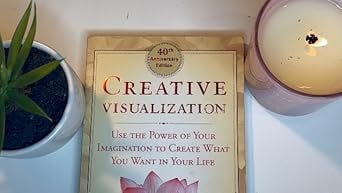
So I tried visualization.
With no practical experience, I did the most hippie thing possible and set up a soft, quiet space with a meditation pillow, a prayer candle, and dried sweetgrass to burn. For months, I earnestly tried to quiet my busy brain long enough to paint a picture of what I wanted, but it felt forced. I had made it too complicated.
Then one day, while standing in the kitchen waiting for the toaster to ding, I realized I was dreaming about the life I wanted.
That was the shift.
I started visualizing casually throughout the week. Nothing formal. After about six months, my life started to take shape. Rather than reacting to the people and events around me, I began making choices. I left a job that made me uncomfortable, and let go of a failed friendship. The change came with relative ease—a new feeling for me.
Now, let’s be clear. The bar was low. I was visualizing some extra money, a decent job, and a boyfriend who didn’t make me question my life choices. “Dream big” had not yet entered the chat.
And yet—it worked. So I raised the bar.
I learned more about how to visualize, which involves deeper imagery and a whole lot of sensory detail (think warm sunshine on your face, feet planted in the grass, and chirping birds overhead). You’ve probably heard how athletes use visualization to help them prepare for races and meets. It’s the same concept. See and feel yourself doing something.

After about a year of elevated visualization, I found myself living in San Francisco. I had always wanted to return to Northern California, but it had been a soft dream floating in the background. The change happened when I slowed down, asked myself what I really wanted, and began to see it clearly.
Once in the Bay Area, I grew content. I stopped thinking about what’s next and settled into the rhythm of daily life—waking up at the same time, taking the same bus to work, and going to the gym during lunch. Lather, rinse, and cry of boredom.
Without realizing it, I put myself back on autopilot.
And that lapse became the lesson.
When I stopped taking time to imagine my future, I stopped shaping it. The choices I was making were default, not deliberate. The guy I was dating was fine enough, but something was missing. My job? Not quite right. Even living in a beautiful but cold city had run its course. I was drifting instead of steering.
Another round of intentional visualization, and I was in sunny Palo Alto, dating my now-husband, and beginning to feel in control again.
Years later, when I began studying goals and goal-setting more formally, I saw the connection. Visualization isn’t separate from goal-setting. It’s the softer front door.
Often overshadowed by our productivity-obsessed culture, my mom’s gentle guidance is forgotten, so I’m here to remind you that daydreaming is necessary.
Before you write a plan, outline next steps, or color-code your calendar, you have to imagine something different. You have to spend time thinking about what you want—and what you don’t. If you skip this step, it’s like hopping in the car for a road trip without entering a destination. Sometimes wandering works, but not when you’re deciding how you want to spend the next phase of your life.
You’ve got to think granular.
Not in vague terms like “I want to be happier.” But in detail. What does a good day look like? Who are you with? How do you feel?
Visualization helped me see the details. And once I could see them, I could act on them.
Most of what we want isn’t the thing itself—it’s the feeling behind it. Not a bigger house or more money in the bank, but the sense of safety, security, love, or freedom those things might bring.
If you’re curious, you can find Creative Visualization on the Libby app or in a used bookstore (I would bet money it’s sitting between a dusty self-help book and Lord of the Flies).
Or you can try a simple version yourself:
Find a quiet space where you won’t be interrupted for 5–10 minutes.
Get comfortable (no ceremonial pillow required).
Start by asking yourself how you want to feel at the end of the day.
Then work backward. What would need to happen for that feeling to be true?
Fill in the details—sights, sounds, even the small textures of the day.
The more specific the picture, the easier it is to move toward it.
If you want a deeper framework—how to connect vision to traditional goals without losing the magic—I teach this inside Path & Purpose. Because I truly believe the next phase of life doesn’t get built by accident. We can use my dad to help us build the plan, and my mom to help us dare to dream about it.
We don’t drift into purpose.
We imagine it first.

👉 workshop starts soon - registration is now open!
This is a free weekly email, and I plan to keep it that way. If you’d like to support my work beyond liking and sharing, please consider upgrading to paid or buy me a coffee. 🥰Completely optional, always appreciated.